
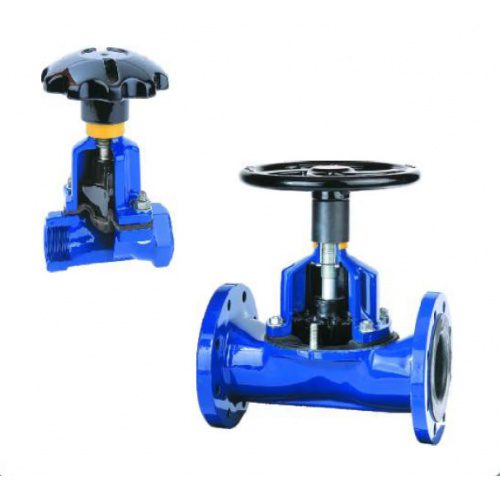
PK Saunders invented the original diaphragm valve in 1928 in the then known West Rand gold fields of Johannesburg. Since then, we have developed our range through innovative designs and by using the latest materials technology. As a result, Saunders diaphragm valves have gained an excellent reputation for versatility and reliability establishing a presence in the mining and every process industry sector. Today there are millions of Saunders diaphragm valves, manufactured by Dynamic Fluid Control and supplied by our distribution partners to South and Southern African markets.
Saunders full bore KB type valve, with their smooth non-turbulent body design have proved to be outstanding in resisting the erosive affects of corrosive/abrasive line media. In addition, the full bore concept is designed for minimum flow resistance whilst allowing rodding out and easy cleaning. The flexible diaphragms ensure consistent leak tightness even when solids, powders and dry media are present. A range of rubber linings are available for the more exacting corrosive and abrasive applications to a maximum working pressure of 10 bar.
The KB valve can be installed in any position without affecting its operation. We recommend six times pipe diameter from pump or bend.
Bonnet assembly lubricated for long life. Needs no further grease. The indicator lip seal stops the ingress of dust, dirt and atmospheric contaminates.
Three part design allows maintenance and actuator retrofitting without removing the valve body from the pipeline. Extended life, reliability and safety, combined with essentially simple design, result in low maintenance and low cost of ownership.
A valve package for corrosive and abrasive applications
BODY / LINING: Cast Iron Ductile Iron (SG)
TYPICAL APPLICATIONS: Strength, low cost non corrosive duties
SIZE: DN15-DN350
TEMP °C: -20° to 175°
BODY / LINING: Rubbers Soft (AAL), Hard (Ebonite) (HRL), Butyl (BL), Neoprene (NL)
TYPICAL APPLICATIONS: Economic handling of corrosive & abrasive media Abrasive duties Acid, chlorinated water, moist chlorine Mineral acids, & slurries Abrasive duties where hydrocarbons are present
SIZE: DN25 – DN350
TEMP °C:
BODY / LINING: Borosilicate Glass
TYPICAL APPLICATIONS: Excellent for strong acids, halogens
SIZE: DN25 – DN200
TEMP °C: -10° to 175°
BODY / LINING: Halar”
TYPICAL APPLICATIONS: Excellent resistance to mineral and oxidising acids inorganic bases, salts
SIZE: DN25 – DN350
TEMP °C: -10° to 150°
BODY / LINING: Fusion Bonded Epoxy FBE
TYPICAL APPLICATIONS: Potable water applications
SIZE: DN25 – DN350
TEMP °C: -20° to 80°
Halar™ is the registered trademark of AUSIMONT UK Ltd
Proofed against corrosion and erosion in hostile environments
A:
GRADE TYPICAL APPLICATIONS: Abrasives in slurry or dry powder form.
SIZE: DN15 – DN350
TEMP °C: – 40° to 90°
B:
GRADE TYPICAL APPLICATIONS: Acid and alkalis. Up to 85% sulphuric acid at ambient temperatures. Hydraulic hydrochloric phosphoric acids, caustic alkalis and many esters. Sea water, very low vapour and gas permeability. Insert gases and many industrial gases.
SIZE: DN15 – DN350
TEMP °C: – 30° to 90°
C:
GRADE TYPICAL APPLICATIONS: Salts in water, dilute acids and alkalis, abrasives.
SIZE: DN15 – DN350
TEMP °C: – 10° to 90°
226:
GRADE TYPICAL APPLICATIONS: Paraffinic and aromatic hydrocarbons, acids, particularly concentrated suplhuric and chlorine applications. Not recommended for ammonia and its derivatives or for polar solvents, e.g. acetone.
SIZE: DN15 – DN250
TEMP °C: –5° to 140°
237:
GRADE TYPICAL APPLICATIONS: Good acid and ozone resistance certain chlorine services.
SIZE: DN15 – DN350
TEMP °C: – 0° to 90°
300:
GRADE TYPICAL APPLICATIONS: For hot water services applications involving steam sterilisations, therefore, ideally suited for brewing and pharmaceutical applications. For services involving continuous high temperature/pressure combinations consult our technical department.
SIZE: DN15 – DN350
TEMP °C: – 20° to 120°
425:
GRADE TYPICAL APPLICATIONS: Salts in water, drinking water.
SIZE: DN15 – DN350
TEMP °C: – 40° to 100°
Key to grade letters / materials: A – Natural Rubber | B – Butyl | C – Nitrile | 226 – Fluororubber | 300 – Butyl | 237 – Hypalon | 425 – Epdm
Contact our industrial sales specialists for a competitive, tailored commercial proposal.